Tag Archives: Author Interview

Q&A with Eugene Yelchin

Q&A with Eugene Yelchin

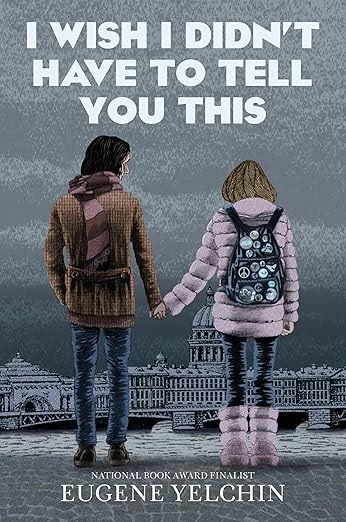
I don’t post many author interviews these days, but I enjoy them. It’s rare that I have a chance to ask questions of an author as widely known as this one. His latest book, I Wish I Didn’t Have to Tell You This, is as haunting as it is relevant.

I read I Wish I Didn’t Have to Tell You This last year, around the end of the summer. It left me thinking about the choices we face as individuals and how we each play a role in a larger story. When I wrote these questions back in November, I had no idea how differently I’d view them after what’s happened in the last two months. I’m grateful for his perspective and willingness to share his hard-won wisdom so frankly.

Note: This post contains affiliate links.

Q&A with Eugene Yelchin

1. In the opening scenes of I Wish I Didn’t Have to Tell You This, you share how your engagement with one of your favorite novels, War and Peace, evolved as you grew up. Has that evolution continued for you? Are there components of Tolstoy’s novel that stand out to you more now than they did before you left Russia?

I still read Tolstoy, but I read him differently than when I was young. Tolstoy’s study of the human nature still fascinates me, but his psychological insights, which guided me in my youth, now serve a different purpose. I’m less interested in “what” than in “how”.  Often, Tolstoy creates a dramatic situation and allows us to view it through several points of view simultaneously. Each point of view is unique, and the characters’ reactions to the situation — expectations, assumptions, illusions, disappointments, etc.— reveal those characters’ psyche. There’s much to learn from Tolstoy, and every time I go back to his work, I learn something new.

2. How was writing I Wish I Didn’t Have to Tell You This different than your memoir of your earlier childhood?

The Genius Under the Table wrote itself. It was the easiest and the most pleasurable experience I have ever had writing. The book is about my family, who despite the constant state of terror, vigilance, and doom managed to fill me with so much of their nutty and noisy Jewish love that it will outlast me and will go on and on in my children and hopefully, their children too. By contrast, I Wish I Didn’t Have to Tell You This was the most difficult project that I have ever attempted exactly because that constant state of terror, vigilance, and doom is also alive and present in me. As a result, reinhabiting the times and the places that I have been trying to forget for years was extremely challenging. But on the brighter side, probably because it was the most difficult book I have ever made, it might also be my best, at least judging by the reaction it receives.

3. Despite the terror and hardship your memoir captures, the story has a lot of humor in it. How did your sense of humor help you through your experiences?

I realize that there is a common belief that humor is helpful in difficult times, and maybe it is, I am not sure. In the case of I Wish I Didn’t Have to Tell You This, humor serves mostly to ease the American readers into the dramatic situations, which (so far) are not familiar to them. At the time and the place described in the book — the Soviet Union of the early 1980s — the humor was much, much darker than I use in the book. The Soviet humor of that period was the humor of a condemned man, the humor of a nihilist. The book is written for the American teens, and I had to be very careful keeping a grip on the sense of despair and hopelessness I had felt back then so that the young American readers will keep reading the book now.

4. When you look at events unfolding in the United States today, do you spot parallels between the government of the Soviet Union and the government of the US? Do you have any advice for young people today who are concerned about the current state of the US and global political climate?

In 2017, the brilliant American thinker, Timothy Snyder, wrote in his pamphlet on tyranny, “When the men with guns who have claimed to be against the system start wearing uniforms and marching with torches and pictures of a leader, the end is nigh. When the pro-leader paramilitary and the official police and military intermingle, the end has come.” It is inspiring to know that even an expert like Snyder could have underestimated American people. The peaceful resistance in Minnesota had proved to us that the end is nowhere in sight. My advice for young people is no different than they have already heard from so many others — join in the peaceful protests (the numbers matter!) and under no circumstances cooperate with the tyrannical regime. Even if it means walking out on the job or out of the classroom, loss of money, comfort, loss of things that we take for granted. Do it now, and that loss will be temporary. Do nothing, and the loss of life itself will not be out of the question in the future.

5. Is there something you wish you had known as a young man that you want to pass on to this new generation?

First and foremost, trust your instincts. We live in the culture, which is loud, pervasive, highly consumerist. This culture forces us to become not who we are but whom it wants us to be. It wants us to be consumers, not citizens. Resist it. Slow down. Question everything and everyone. Do not act emotionally; even if you feel something, it doesn’t mean that it’s true. To learn how to trust your instincts, read real literature. 

6. What do you most hope that readers take away from your memoir?

When I began work on the book about living under an oppressive regime, I envisioned it as a warning to those living in freedom. Democracy is rare and fragile; what would Americans do if they were at risk of losing it? It was a hypothetical question but soon after the book was released, Americans were on the streets protesting the rise of tyranny with No Kings marches. My hope is that my readers will not take democracy they had inherited for granted. That courage is required to defend it. Individually they may not have that courage, but united, they do.

7. What is one question about your memoir that readers often ask you?

Is it true?

Yes, it is.

About I Wish I Didn’t Have to Tell You This

Amazon | Bookshop | Goodreads | My Review

In a stunning sequel to The Genius Under the Table, Eugene Yelchin’s graphic memoir depicts his harrowing journey from Leningrad’s underground art scene to a state-run Siberian asylum—and to eventual safety in the US.

No longer the creative little boy under his grandmother’s table, Yevgeny is now a young adult, pursuing his artistic dreams under the constant threat of the KGB’s stranglehold on Russia’s creative scene. When a chance encounter with an American woman opens him up to a world of romance and possibility, Yevgeny believes he has found his path to the future—and freedom overseas.

But the threat of being drafted into the military and sent to fight in Afghanistan changes everything in a terrible instant, and he takes drastic measures to decide his fate, leading to unthinkable consequences in a mental hospital.

With bold art bringing a vivid reality to life, National Book Award Finalist and Newbery Honoree Eugene Yelchin’s sequel to the acclaimed memoir The Genius Under the Table returns to Yevgeny’s saga, balancing the terror and oppression of Soviet Russia with the author’s signature charm and dark wit. I Wish I Didn’t Have to Tell You This shines a stark spotlight on history while offering a poignant, nuanced, and powerfully resonant look at growing up in—and ultimately leaving—Cold War Russia in the early 1980s.

About Eugene Yelchin

Website | Instagram

Eugene Yelchin is a National Book Award finalist for The Assassination of Brangwain Spurge co-authored with M. T. Anderson and the recipient of Newbery Honor for Breaking Stalin’s Nose. He received Sydney Taylor Award for The Genius Under the Table, Golden Kite Award for The Haunting of Falcon House, Crystal Kite Award for illustrating Won Ton, National Jewish Book Award for illustrating The Rooster Prince of Breslov, and Tomie DePaola Award from the Society of Children Books Writers and Illustrators. His books were named Best Books of the Year by the New York Times, People Magazine, Wall Street Journal, Washington Post, Boston Globe, USA Today, Amazon, NPR, Huffington Post, Publishers Weekly, Kirkus Reviews, Horn Book, School Library Journal, etc., and were translated in fourteen languages.

Author Q&A with Callie C. Miller

Q&A with The Hunt for the Hollower Author Callie C. Miller

Today, I have the awesome privilege to host a Q&A with THE HUNT FOR THE HOLLOWER author Callie C. Miller. I loved all the playful elements of this middle grade fantasy novel, so I was really excited to have the chance to chat with the author about the inspiration behind some of her characters and what might be coming next fall in the sequel, THE SEARCH FOR THE SHADOWSOUL.

Let’s get to it!

I find that a story is often inspired by a question. Was there a question that inspired you to write THE HUNT FOR THE HOLLOWER?

HOLLOWER was an interesting writing process for me. There wasn’t a question, but I had Merlynda, Neci, and Iggy very firmly in my mind. I knew they each wanted to be true to themselves, and knew that they existed in a medieval-inspired world, and knew that this story would be full of things that made me laugh, but I didn’t understand what my characters’ journeys were until several drafts in. I was a less experienced writer when I started their story, and had to grow myself as a person in order to help the characters grow in turn.

One of my favorite characters is the wyvern. He’s so unexpected. I loved that he longs to taste funnel cake (who can blame him?). What inspired you to create him?

I love flipping expectations on their heads! Wyverns and dragons are typically depicted as large and vicious creatures, so the idea of Iggy being small and perfectly content to sunbathe amused me (though of course he’s still a beast to be reckoned with!). His voice came to me very clearly. He is funny and fierce, and even if he’s a little afraid of what’s to come he’ll rise to the occasion for his friends and the greater good.

Who is your favorite character? Are there things about your favorite character that couldn’t be included in the story?

I love all of my characters! But my favorites to write in HOLLOWER are definitely Iggy and Fang. Fang originally had a few more sections from her perspective, but they ultimately weren’t moving the story forward so I cut them.

Is there a scene or moment in the story that really sticks with you? Can you tell us a little bit about it and why it is so special to you?

Percy vanishing through the portal hurts my heart every time! Percy is, in a sense, Merlynda’s rock. She’s lost her brother, her partner in crime, and the security that when her magic goes awry, someone will be able to set it right. The fact that she feels responsible for Percy disappearing only twists the knife further. She’s heartbroken, and devastated, and terrified. This is the moment that makes the story so incredibly personal for Merlynda. It took me several drafts to get here, but once I did, everything clicked into place.

What do you most hope that readers take away from your novel?

Embrace all of you with your whole self. Many people will try to write the narrative of You, but ultimately you are empowered to decide who you are. And that somewhere out there, there are people who will love you as you are. If you haven’t found these friends yet—Courage, dear heart! You one day will!

You mentioned that the sequel to THE HUNT FOR THE HOLLOWER comes out next fall. I know I’m excited to read it. What do you think readers who enjoyed the first book in the series will be most excited to see in the sequel?

I hope they’ll be excited about all of it! My goal is for THE SEARCH FOR THE SHADOWSOUL to feel tonally similar to HOLLOWER, but still move the characters forward in a meaningful way. It’s another fun fantasy romp, but we’ll follow a different main character as they work through how they’ve been affected by the events of HOLLOWER. Our questers will reunite with old friends, make new ones, and encounter a mysterious form of magic that even Merlynda doesn’t know about!

About Callie C. Miller

Instagram | Twitter | Website

Callie C. Miller writes for animated television shows, a video game company, and (most importantly) herself. When she’s not writing, Callie is most likely reading comics or playing video games or dreaming about hot chocolate. (Hot chocolate is very important nourishment for writers.) She received her MFA in Writing for Children & Young Adults from the Vermont College of Fine Arts. THE HUNT FOR THE HOLLOWER is Callie’s debut novel. Visit her at www.calliecmiller.com

About The Hunt for the Hollower

Review | Amazon | Bookshop | Goodreads

In this riff on Arthurian legend, a wizardess who is still mastering her powers goes on an epic quest to save her brother from an evil wizard in this “sweet and fun” middle grade adventure that’s “sizzling with magic” (Adam Rex, New York Times bestselling author) and is perfect for fans of Adam Gidwitz and Amanda Foody!

The great wizard Merlyn prophesized that his seventh descendant would do wonderful, miraculous things—baffling everyone when his great-great-many-times-great grandchild turns out to be twins . Soon enough, however, it becomes clear which sibling is the Septimum Percy is a natural with magic. Merlynda (to put it simply) is not.

But Merlynda doesn’t mind. Percy has always been by her side to cheer her up (and clean up) after her magical bungles—until the twins attempt a forbidden spell to help her control her magic, and Percy vanishes through a portal and straight into the clutches of the magic-stealing, mythical Hollower.

Aided by her best friend (who longs to be a knight), a wandering musician (who is fleeing from his past), and her brand-new, fierce familiar (who yearns for a taste of funnel cake), Merlynda sets off on a quest to rescue her brother. But to defeat this ancient evil, she must discover and embrace her true powers—or else lose her brother for good.

Q&A with Sentences Book Donations Founder Clinton Festa

Almost ten years ago, I spoke with Clinton Festa about a really cool charity he founded called Sentences Book Donations. Through Sentences, he helps people donate books to prisons and other similar facilities. He does all the research for you. Simply pop onto the Sentences Facebook and Goodreads pages to find a place accepting donations. He’ll list what types of books facilities are interested in and how to send them. Then, you simply box up your donation and head to the post office to send it directly to the facility.

It’s been so long since my original interview that I thought it would be fun to check in. I’m curious what’s changed and how the book donation ministry is going now.

Q & A with Sentences Book Donations Founder Clinton Festa

Welcome back! I cannot believe it’s been almost ten years since we first spoke about your ministry, Sentences Book Donations. Can you start us off with a quick refresher on the goal of Sentences?

Glad to be back! In 2014 I was just getting started, but the goal today is the same: to link book donors with prison libraries so they can donate exactly what the prisons need. We contact prisons directly to find out specifically what the residents are requesting, so the donors have reliable information and can make an efficient donation. Then we share that information on Facebook and Goodreads so that the donors can see what they have and are willing to donate, knowing their donated books will be read and enjoyed.

When we last spoke, Sentences was nearing the end of its first year of operation. Now, you’re coming up on ten years. What’s something unexpected that you’ve learned about the prison system and getting books into the hands of inmates in the last ten years?

How much the donation difficulty level varies from prison to prison. Some states have vastly different security measures, and some facilities have very specific policies. Others can be as easy to donate to as Goodwill. I guess they all have to determine their policies as needed, but if the donor needs to know anything to make a donation, I’ll include that in the posting for the facility.

I know each facility has its own guidelines or requirements for what they hope people will donate. The requests can vary a great deal. What are some common genres or formats you frequently see requests for?

The general rule is that if it’s popular on the outside, it’s popular inside the prison system. They also tend to like recently published fiction, just like the rest of us. However, there are a couple differences.  Although the height of popularity for the Western genre has long passed on the American book market, they’re still in very high demand inside prisons. They’re also usually thin, small paperbacks, which get worn out quickly, so if you have any Westerns, please consider donating! Many facilities are also in great need of Spanish-language reading.

Have you noticed any change in the last ten years? Is it easier or more difficult to donate books these days?

I’ve actually seen it get easier over time. When I started, there were usually more barriers to donating (depending on the facility or the state policies), like forms to fill out in advance, policies preventing sharing the information on social media, and just a general reluctance to receive books via USPS directly from unknown donors. Today it’s gotten less restrictive, which is great, but some places will still only receive books shipped directly from a vendor for safety and security reasons.

Are you in contact with facilities after they receive donations? Have you heard stories about the books’ impact on the inmates’ lives? Anything in that vein that you’d like to share?

Yes, and that all depends on the librarian. I’ve met some truly dedicated and passionate professionals who have been wonderful to work with.  The follow-up stories usually come not after I contact them to get their needs and donation instructions; it comes following a donation. I’ve got some really wonderful thank-you notes and e-mails over the years that I still hang on to. Anyone who donates may get one of these responses, depending on the individual librarian. It’s really nice when they do that. It makes it real.

When we spoke back in 2014, you calculated that hundreds of pounds of books had been donated through Sentences Book Donations. Have you continued to track book donations? What would you estimate has been donated from the beginning of the organization to now?

Great question. By now, it’s thousands, but I don’t have very accurate numbers. When I share the information, it’s up to the donors to bring their books to the USPS to donate. Always ask for the media rate! You can ship a ton of books across the country for surprisingly little money. But since the donors ship directly to the prisons, I don’t know how much they send unless they tell me or unless the librarian lets me know. If you do donate, I’d love to hear from you! If you have pictures of your donation before you send it, I’d love for you to post them on our pages!

Is there a process you prefer for donors to follow? Anything they should include in their packages when they send books?

Each posting may have specific instructions, so just keep an eye on that when you donate. Usually, just putting the books in a cardboard box, going to the Post Office, and asking for the media rate will work.  But always include a return address on the box. That’s a security thing; most prisons will have a policy that they’ll have to discard anything they receive if it doesn’t have a return address.

Are there any parting thoughts or resources you’d like to share?

I’d just like to thank everybody who has donated and encourage anybody who is considering it. If you have books on the shelf that are gathering dust, they can get new life and be greatly appreciated by people who have limited recreational options. Donating is very easy and not that expensive as long as you ask the Post Office for the media rate. Also, if you see a place you’d like to donate to on our page, but the instructions were posted over a year ago, feel free to reach out to me via Facebook and Goodreads pages. I’ll give the prison a call and verify the info is current. Thank you for donating!

Have you donated books through Sentences?

I recently donated the books pictured in the box above. I hope to donate another box before the end of the year.

Have you heard of Sentences before? If so, have you ever donated books using the listings on Facebook or Goodreads? Are you planning to, now that you’ve heard about it? Leave a comment and let me know.

Author Q&A with Bookerlunds Taya and Nathan Okerlund

Author Q&A with Bookerlunds Taya and Nathan Okerlund

I knew from the moment that I first read about this book that I would request to review it. The book description and email from the author were so cleverly worded and in such a great voice! I couldn’t resist. So, I was even more thrilled when the authors offered to let me host them for a Q&A post.

If you haven’t checked out my review of NEVER LORE, please pop over there either before or after reading this post because if you like fantasy adventure middle grade books, you do NOT want to miss this one.

Let’s get to the Q&A with the Bookerlunds!

1. I find that a story was often inspired by a question. Was there a question that inspired you?

Never Lore is a spy story and spy stories are full of deceit. Early on in my career, after receiving my security clearance, I learned about people who could avoid detection in their lies by being strictly factual, without a hint of honesty. Honesty is a nuanced thing and the way adults typically model it for children, it can be kind of hard to crack. I raised a number of questions for kids to think about in this story. I hope I used enough restraint in not answering all of them for the reader. It’s a fact, I come down on the side of truth, but a story won’t really resonate when it lies to you. And I wouldn’t do that.

2. Who is your favorite character? Are there things about your favorite character which couldn’t be included in NEVER LORE?

Annabelle was partly inspired by my fearless niece. In fact, her name is Annabelle. She’s pretty grown up now, but wow was she a firecracker when she was nine! So many stories about that kid! So many broken bones! Is she up to eight or nine? I’m not sure I captured her with quite the same spirit, but I gave it a go!

3. What was the most difficult thing about writing NEVER LORE?

This book was at least six years in the making. While it is crucial to follow the rules of story craft and to accept feedback, an author can lose her way by caring too much about what someone else thinks of her book. This one took me time to find the all-important-element that no story expert can give a writer—Voice

4. Is there a scene or moment in your novel that really sticks with you? Can you tell us a little bit about it?

I still love the night hyena scene. My daughter was only four when I began writing Never. At the time, we watched quite a few nature documentaries together, and there was this episode where an injured mother hyena was turned out of her pack with her babies. The little exiles didn’t make it, and it gutted my little girl to see this, so she asked me to put hyenas in the story. I wrote up the scene, and thought it was pretty good, until my husband got hold of it and proceeded to set it on fire! It’s still my favorite scene, mostly because it’s the product of our whole family collaborating together.

5. What was the most challenging thing you had to overcome as a writing team in order to finish NEVER LORE?

I don’t like to talk about this, because it’s still tender to me, but I went through years of painful disability and a slow and painful healing process before I was able to both finish and see Never through to publication.

6. What do you most hope readers take away from your novel?

I hope readers have a great adventure! As a bonus, I hope they will sometimes think about hard questions like: what is a lie? What is the truth? And in either case—what happens next?

7. What is one question about your novel you are often asked by readers?

As I mentioned, Never was a bit of a family project, and so people might wonder what or who BOOKERLUNDS is. Our family name is Okerlund. So we added a couple of letters and thought we were being clever. In any case, we are definitely bookish people.

About Bookerlunds Taya and Nathan Okerlund

Facebook | Instagram | Website

The Bookerlunds are an author team composed of Taya and Nathan Okerlund and their daughter Mimi. (Mimi made meaningful contributions to this book by insisting that hyenas make it into the manuscript.) And we’re glad she did.

Nathan is a neuroscientist who works in a laboratory at the University of Utah, studying model organisms such as nematodes to try to unlock the mysteries of neuro degeneration, or declines in the functioning of the brain. He has published a lot of papers before in peer reviewed journals, but this is his first work of fiction.

Taya is a multi award-winning author of SHIN and other novels. NEVER LORE is her first middle-grade novel.

About Never Lore: Journey to Mt. Smolder

Amazon | Bookshop | Goodreads | My Review

NOTICE: Explosive content contained within. (Rebel boys and indomitable girls have always been a combustible combination.)

All the signs of Fairy’s unraveling were there: a strict rationing of pixie dust; the disappearance of a magical species; a reckless reliance on spies plucked from human orphanages. Annabelle was no orphan. Her father was perhaps the most infamous man in Childerbridge-and she’d never live down the shame of it, though she’d also never accept that the charges against him were true-not most of the time. 

She’ll have to go to the end of Never to prove what is true…about Never itself, about her father, and her own work-worn self.

Author Q&A with Jacqueline Jules

Author Q&A with Jacqueline Jules

Today, I’m excited to share a Q&A with the author of more than 50 books for young readers, and most particularly, the author of My Name is Hamburger, which I reviewed yesterday. Jacqueline Jules shares some of the inspiration behind favorite characters, why she chose to write Trudie Hamburger’s story in verse, and more.

Q: What is your favorite thing about Trudie Hamburger? What inspired you to create her?

Trudie is a version of myself at her age. My Name is Hamburger was inspired by my own childhood in a small southern town as a Jewish minority. Writing this book gave me the opportunity to recall both pleasant and not-so-pleasant memories of growing up.

Q: Who is your favorite character in the story? Were there things about your favorite character which couldn’t be included in the novel?

My favorite character in My Name is Hamburger is Daddy. This character was modeled after my own father who was a German speaking Jewish immigrant. Like Daddy in My Name is Hamburger, my father loved flowers and enjoyed visiting the cherry blossoms in Washington, DC. A big difference between Trudie’s father and my own is his profession. My father worked in a winery. He wore a tan uniform to work and came home each night smelling of fermented grapes. However, I felt a father who worked in a winery would be distracting in my middle grade novel. So I chose to make Trudie’s father the owner of a print shop because ink also carries a distinctive smell.   

Is there a scene or moment in your novel that really sticks with you? Can you tell us a little bit about it?

There is a place in the novel where Trudie realizes that she has made an unfair assumption. She blames the bully who has been tormenting her for something he did not do. When she learns the truth, she says “The news should make me feel better. No one tried to hurt me. It just happened.” Sometimes, we suffer difficult situations and loss. There is no one to blame. It is a reality everyone must face at some point in their lives.     

My Name is Hamburger is set in Virginia in 1962. What made you choose that particular time and setting?

Since this novel was inspired by my childhood, I needed it to take place in an era and town similar to my own experiences. It was a challenge at times, to make sure the things I recalled took place in the year of the novel. For example, in the final editing stages, I had to take out a particular brand of bike which was popular after 1962. Historical fiction requires research, even if the era is personally familiar to the author.

What made you decide to write Trudie’s story in verse?

Poetry is and was my first love as a writer. I love the compression and imagery of poetry as well as the challenge of packing volumes of meaning into a few lines. I am the author of four books of poetry for adults and a collection for young people titled, Tag Your Dreams: Poems of Play and Persistence. My first drafts of Trudie’s story were written in prose. Her voice didn’t truly emerge until I began writing the story in verse. 

What do you most hope that readers take away from My Name is Hamburger?

I hope this novel increases empathy and understanding. Jews make up only 0.2% of the world’s population. Many young readers may not have the experience of meeting a Jewish person outside of a book. While My Name is Hamburger is historical fiction, Trudie’s experiences with anti-Semitism and anti-immigrant sentiments are relevant today.

About Jacqueline Jules

Facebook | Twitter | Website

A former elementary school librarian, Jacqueline Jules is the author of over fifty books for young readers including My Name is Hamburger, which is a PJ Our Way selection. Her other books for young readers include The Porridge-Pot Goblin, Drop by Drop: A Story of Rabbi Akiva, Picnic at Camp Shalom, The Generous Fish, Feathers for Peacock, and Never Say a Mean Word Again. She is also the author of two chapter book series, Zapato Power and Sofia Martinez. Visit her online at www.jacquelinejules.com

About My Name is Hamburger

Amazon | Bookshop | Goodreads

Say your name with pride!

Trudie Hamburger is the only Jewish kid living in the small southern town of Colburn in 1962. Nobody else at her school has a father who speaks with a German accent or a last name that means chopped meat. Trudie doesn’t want to be the girl who cries when Daniel Reynolds teases her. Or the girl who hides in the library to avoid singing Christian songs in music class. She doesn’t want to be different. But over the course of a few pivotal months, as Trudie confronts her fears and embraces what she loves–including things that make her different from her classmates–she finally finds a way to say her name with pride.

Author Q&A with Samara Shanker

Author Q&A with Samara Shanker

I recently read NAOMI TEITELBAUM ENDS THE WORLD. It was such a fun book that I wanted to find out more about the inspiration behind it. So today I’m super excited to share my Q&A with author Samara Shanker. She’ll tell us a bit about what inspired her gloriously fun debut novel and drop a few hints about what’s coming next. First, here’s a little bit about the book…

About Naomi Teitelbaum Ends the World by Samara Shanker

Amazon | Bookshop | Goodreads

A magical Bat Mitzvah gift gets out of control and thrusts a girl into a supernatural quest with the fate of the world at stake in this spooky middle grade adventure that’s perfect for fans of Aru Shah.

Naomi Teitelbaum is so ready for her Bat Mitzvah. Her prayers are memorized and she’s definitely got a handle on her Torah portion (well, almost). Then she gets a mysterious gift: a tiny clay Golem. To Naomi’s shock, it comes to life—and obeys her every command.

At first, this small magical helper seems like the best Bat Mitzvah gift ever. But with each command, the Golem grows…and gets harder to hide. And creepy, unnatural creatures like dybbuks, demons, and a congregation of ghosts have started following Naomi around. To keep herself out of trouble and the Golem out of harm’s way, Naomi gives the Golem well-intended instructions: save the world.

Unfortunately, this leaves more room for interpretation than Naomi thought. Before long, the Golem is wreaking havoc all over Los Angeles, and only Naomi and her friends can stop it.

Author Q&A with Samara Shanker

Q: I find that a story was often inspired by a question. Was there a question that inspired you to write Naomi Teitelbaum Ends the World?

Sort of. I’ve always been really interested in golem stories, and I guess the question that stuck with me was “what would this idea of a worker with no nuance but endless energy look like in the hands of a kid with strong convictions but no strong sense of how to apply them?” So Naomi was born.

Q: Who is your favorite character in the book? Were there things about them which couldn’t be included in the story?

I adore all the kids, but I think my favorite character is Becca. All the kids are unapologetically themselves, but Becca doesn’t really have a choice. She has to wear her experiences on her sleeve because she feels everything so strongly. It’s no wonder she ended up best friends with Naomi. I wrote Becca for my nephew, who is still too little to read, but is on a similar trajectory to Becca’s particular struggles, so I hope I did her justice. I’m so lucky and excited that I get to spend more time exploring the world from Becca’s point of view in the second book.

Q: The Golem does some interesting things in the book as it tries to follow Naomi’s instructions. What’s your favorite moment or scene involving the Golem? What inspired you to create that moment?

I just love golems. I could talk about the incredible history and inspiration behind the creation of an entity like that forever, but I think in the story my favorite moment with the Golem has to be the last one. No spoilers, but I think that moment is where we really see Naomi understand what it means to take responsibility, rather than trying to just shoulder the problems of the world alone. For the Golem, it’s a little bittersweet. Golems have always raised questions of agency for me, and what it means to have been created for a singular purpose. I think in a sense Naomi’s Golem has achieved his purpose at the very end, it’s just not quite what Naomi thought it was.

Q: Is there a scene or moment in your novel that really sticks with you? Can you tell us a little bit about it?

There’s a moment where the kids are having a conversation with Rabbi Gershon in the temple in Santa Clarita. They’re tired, they’re scared, they’re incredibly out of their depth, and this ghost is teaching them Talmud, and discussing golems, and Naomi asks the question, “but what if we love it?” and I think that really is just the core of Naomi’s character. She’s intense and a little insufferable sometimes, but she’s entirely motivated by love, and that matters.

Q: Naomi’s relationships with her best friends Eitan and Becca are the central relationships in the story. What is your favorite thing about Becca or Eitan?

So I talked a little about Becca up above. But I think my favorite thing about her is the ways she extends trust. Emotional expressions aren’t really her thing, but handing Eitan her maps means something to both of them. It’s a concrete way of showing that she trusts and loves her friends. My favorite thing about Eitan is his unexpected complexity. I think it would be very easy for him to be just a nerd, or just the boy on the crew, but he’s the one who needs physical comfort more than anyone else, and he bakes well enough that he made a full-sized American Girl doll cake for his cousin, and he just DESPERATELY wants to go to space camp, which I relate to wholeheartedly.

Q: I feel like it used to be rarer to see a story set in Los Angeles, but now I tend to see that city as a setting more often. What made you choose Los Angeles as the setting for your story?

Honestly it was a strategic choice. I have a bit of a quirk of setting a lot of my writing in small town New England, but you don’t find so many Jews there, and it felt a little cliché to set a Jewish story in New York, but there is actually a really big Jewish community in L.A.. It’s also an area pretty immediately affected by climate change in particular, so it made sense for Naomi. Plus I had friends there I could consult on geography, and I desperately need help on all things geographical.

Q: What do you most hope that readers take away from your novel?

I am so proud of this generation of kids. All of them are so passionate about changing the world and making the future better. I wrote this book as kind of a love letter to them, and to remind them that it’s not all on them. “You are not obligated to complete the work.” Burnout doesn’t help anyone; it’s not only ok but necessary to stop and enjoy life without feeling guilty about work you’re not doing.

Q: What is one question about your novel you are often asked by readers?

Who sent the golem? And my answer is: There’s going to be a second book next year!

About Samara Shanker

Samara Shanker has been making up stories about magic and monsters since she was a kid sneaking in extra reading past her bedtime. By graduate school, she had moved on to writing stories that reimagined the folklore and mythology she had always loved as a kid (mostly still written after bedtime, once she finished all her sensible homework). She now works as a tutor and children’s literacy specialist and gets to do most of her writing during the day, which has done wonders for her sleep schedule. She lives in Virginia with her rescue puppy, Jack Kirby, and devotes most of her time not spent working or writing to spoiling her niece and nephew. NAOMI TEITELBAUM ENDS THE WORLD is her debut novel.