
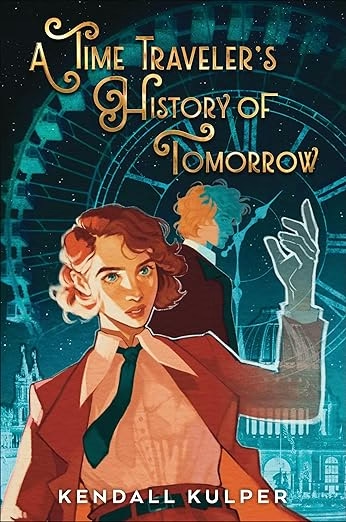
A Time Traveler’s History of Tomorrow
Kendall Kulper
Holiday House
Published November 4, 2025
Amazon | Bookshop | Goodreads
About A Time Traveler’s History of Tomorrow
A time-bending love story between a prickly young woman and a carefree stranger, who are tasked with saving the universe—after accidentally destroying it in the first place.
Genevieve Newhouse and Ash Hargreaves weren’t supposed to meet like this. Unless it was always meant to be . . .
Gen is a fastidious science prodigy with a chip on her shoulder, and she can turn herself invisible.
Happy-go-lucky Ash has just escaped a sheltered (read: cultish) childhood, and he can manipulate time.
The gifted eighteen-year-olds cross paths at the 1934 Chicago World’s Fair, where Genevieve’s experimental physics project causes an apocalyptic explosion. Ash tries to avert catastrophe by gallantly rewinding time a few minutes, but instead, he transports them back to 1893. The duo finds themselves trapped in an unfamiliar, unwelcoming era, with no idea how to return to their own time—or if their own time even exists. Their cataclysmic leap across decades might have destroyed the world as they know it . . .
Fate and free will intertwine in this page-turning historical romance that sets two irresistible strangers down a chaotic, potentially apocalyptic path. “Will they or won’t they” takes on a whole new meaning as Gen and Ash fight for survival while falling in love.
Hand to fans of Immortal Longings and Anatomy: A Love Story, and don’t miss companion novels Murder for the Modern Girl and A Starlet’s Secret to a Sensational Afterlife.
A Junior Library Guild Gold Standard Selection


My Review
I read The Starlet’s Secret to a Sensational Afterlife by Kendall Kulper, which is about Genevieve’s sister Henny, two years ago, so I was excited to read this companion novel. The historical setting has the same noir feel as the other book, which I love. Most of the story takes place in Chicago in 1893, in and around the World’s Fair.
The chapters alternate from Genevieve and Ash’s perspectives, and I enjoyed both characters. I like that she is the scientist and he is the romantic, people-oriented person in the partnership. It would have been easy to write the characters the opposite way, and I like that Kulper challenged some gender expectations with these characters. Genevieve also finds a talented Black woman in 1893 who mentors her. That created some opportunities for the narrative to note the ways that misogyny didn’t only affect white women, but also women of color.
The pacing in the last quarter of the book felt so fast to me. I loved how quickly things unfolded, though I think I lost the thread of the character arcs for both Genevieve and Ash as they prepared for their big move to save the world and un-pretzel the timeline.
Despite that, I had a lot of fun reading this book. I didn’t realize that Genevieve and Henny’s older sister, Ruby, has her own novel: Murder for the Modern Girl. So I’m definitely adding that one to my reading list.
Definitely check out Kulper’s books if you enjoy a good historical novel with a bit of magical realism or fantasy elements.

Content Notes
Recommended for Ages 13 up.
Profanity/Crude Language Content
Mild profanity used fairly infrequently.
Romance/Sexual Content
Kissing.
Spiritual Content
Some characters have supernatural abilities, like traveling through time and turning invisible. At the beginning of the story, one character lives in a highly controlling religious cult community.
Violent Content
Situations of peril. Two scenes include a person nearly falling to their death. Two scenes include someone nearly drowning. One person dies in the water. Someone collapses with some kind of apparent medical crisis. Reference to death in a fire (not shown on scene).
Misogynistic and racist characters restrict the ability of talented women and people of color to participate in the science field and/or receive credit for their work. References to the World’s Fair in Chicago in 1893 and the Indigenous people and people of color incarcerated at the fairgrounds as part of an exhibit. The narrative also acknowledges the fact that certain cultures and people groups were excluded from exhibits on progress and science.
Drug Content
None.
Note: This post contains affiliate links, which do not cost you anything to use but help support this blog. I received a free copy of this book in exchange for my honest review. All opinions are my own.