Tag Archives: Resistance

Q&A with Eugene Yelchin

Q&A with Eugene Yelchin

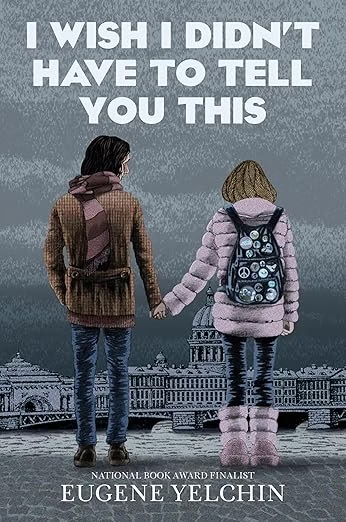
I don’t post many author interviews these days, but I enjoy them. It’s rare that I have a chance to ask questions of an author as widely known as this one. His latest book, I Wish I Didn’t Have to Tell You This, is as haunting as it is relevant.

I read I Wish I Didn’t Have to Tell You This last year, around the end of the summer. It left me thinking about the choices we face as individuals and how we each play a role in a larger story. When I wrote these questions back in November, I had no idea how differently I’d view them after what’s happened in the last two months. I’m grateful for his perspective and willingness to share his hard-won wisdom so frankly.

Note: This post contains affiliate links.

Q&A with Eugene Yelchin

1. In the opening scenes of I Wish I Didn’t Have to Tell You This, you share how your engagement with one of your favorite novels, War and Peace, evolved as you grew up. Has that evolution continued for you? Are there components of Tolstoy’s novel that stand out to you more now than they did before you left Russia?

I still read Tolstoy, but I read him differently than when I was young. Tolstoy’s study of the human nature still fascinates me, but his psychological insights, which guided me in my youth, now serve a different purpose. I’m less interested in “what” than in “how”.  Often, Tolstoy creates a dramatic situation and allows us to view it through several points of view simultaneously. Each point of view is unique, and the characters’ reactions to the situation — expectations, assumptions, illusions, disappointments, etc.— reveal those characters’ psyche. There’s much to learn from Tolstoy, and every time I go back to his work, I learn something new.

2. How was writing I Wish I Didn’t Have to Tell You This different than your memoir of your earlier childhood?

The Genius Under the Table wrote itself. It was the easiest and the most pleasurable experience I have ever had writing. The book is about my family, who despite the constant state of terror, vigilance, and doom managed to fill me with so much of their nutty and noisy Jewish love that it will outlast me and will go on and on in my children and hopefully, their children too. By contrast, I Wish I Didn’t Have to Tell You This was the most difficult project that I have ever attempted exactly because that constant state of terror, vigilance, and doom is also alive and present in me. As a result, reinhabiting the times and the places that I have been trying to forget for years was extremely challenging. But on the brighter side, probably because it was the most difficult book I have ever made, it might also be my best, at least judging by the reaction it receives.

3. Despite the terror and hardship your memoir captures, the story has a lot of humor in it. How did your sense of humor help you through your experiences?

I realize that there is a common belief that humor is helpful in difficult times, and maybe it is, I am not sure. In the case of I Wish I Didn’t Have to Tell You This, humor serves mostly to ease the American readers into the dramatic situations, which (so far) are not familiar to them. At the time and the place described in the book — the Soviet Union of the early 1980s — the humor was much, much darker than I use in the book. The Soviet humor of that period was the humor of a condemned man, the humor of a nihilist. The book is written for the American teens, and I had to be very careful keeping a grip on the sense of despair and hopelessness I had felt back then so that the young American readers will keep reading the book now.

4. When you look at events unfolding in the United States today, do you spot parallels between the government of the Soviet Union and the government of the US? Do you have any advice for young people today who are concerned about the current state of the US and global political climate?

In 2017, the brilliant American thinker, Timothy Snyder, wrote in his pamphlet on tyranny, “When the men with guns who have claimed to be against the system start wearing uniforms and marching with torches and pictures of a leader, the end is nigh. When the pro-leader paramilitary and the official police and military intermingle, the end has come.” It is inspiring to know that even an expert like Snyder could have underestimated American people. The peaceful resistance in Minnesota had proved to us that the end is nowhere in sight. My advice for young people is no different than they have already heard from so many others — join in the peaceful protests (the numbers matter!) and under no circumstances cooperate with the tyrannical regime. Even if it means walking out on the job or out of the classroom, loss of money, comfort, loss of things that we take for granted. Do it now, and that loss will be temporary. Do nothing, and the loss of life itself will not be out of the question in the future.

5. Is there something you wish you had known as a young man that you want to pass on to this new generation?

First and foremost, trust your instincts. We live in the culture, which is loud, pervasive, highly consumerist. This culture forces us to become not who we are but whom it wants us to be. It wants us to be consumers, not citizens. Resist it. Slow down. Question everything and everyone. Do not act emotionally; even if you feel something, it doesn’t mean that it’s true. To learn how to trust your instincts, read real literature. 

6. What do you most hope that readers take away from your memoir?

When I began work on the book about living under an oppressive regime, I envisioned it as a warning to those living in freedom. Democracy is rare and fragile; what would Americans do if they were at risk of losing it? It was a hypothetical question but soon after the book was released, Americans were on the streets protesting the rise of tyranny with No Kings marches. My hope is that my readers will not take democracy they had inherited for granted. That courage is required to defend it. Individually they may not have that courage, but united, they do.

7. What is one question about your memoir that readers often ask you?

Is it true?

Yes, it is.

About I Wish I Didn’t Have to Tell You This

Amazon | Bookshop | Goodreads | My Review

In a stunning sequel to The Genius Under the Table, Eugene Yelchin’s graphic memoir depicts his harrowing journey from Leningrad’s underground art scene to a state-run Siberian asylum—and to eventual safety in the US.

No longer the creative little boy under his grandmother’s table, Yevgeny is now a young adult, pursuing his artistic dreams under the constant threat of the KGB’s stranglehold on Russia’s creative scene. When a chance encounter with an American woman opens him up to a world of romance and possibility, Yevgeny believes he has found his path to the future—and freedom overseas.

But the threat of being drafted into the military and sent to fight in Afghanistan changes everything in a terrible instant, and he takes drastic measures to decide his fate, leading to unthinkable consequences in a mental hospital.

With bold art bringing a vivid reality to life, National Book Award Finalist and Newbery Honoree Eugene Yelchin’s sequel to the acclaimed memoir The Genius Under the Table returns to Yevgeny’s saga, balancing the terror and oppression of Soviet Russia with the author’s signature charm and dark wit. I Wish I Didn’t Have to Tell You This shines a stark spotlight on history while offering a poignant, nuanced, and powerfully resonant look at growing up in—and ultimately leaving—Cold War Russia in the early 1980s.

About Eugene Yelchin

Website | Instagram

Eugene Yelchin is a National Book Award finalist for The Assassination of Brangwain Spurge co-authored with M. T. Anderson and the recipient of Newbery Honor for Breaking Stalin’s Nose. He received Sydney Taylor Award for The Genius Under the Table, Golden Kite Award for The Haunting of Falcon House, Crystal Kite Award for illustrating Won Ton, National Jewish Book Award for illustrating The Rooster Prince of Breslov, and Tomie DePaola Award from the Society of Children Books Writers and Illustrators. His books were named Best Books of the Year by the New York Times, People Magazine, Wall Street Journal, Washington Post, Boston Globe, USA Today, Amazon, NPR, Huffington Post, Publishers Weekly, Kirkus Reviews, Horn Book, School Library Journal, etc., and were translated in fourteen languages.

MMGM Review: The Lion’s Run by Sarah Pennypacker

The Lion’s Run
Sarah Pennypacker
Illustrated by Jon Klassen
Balzer + Bray
Published February 3, 2026

Amazon | Bookshop | Goodreads

About The Lion’s Run

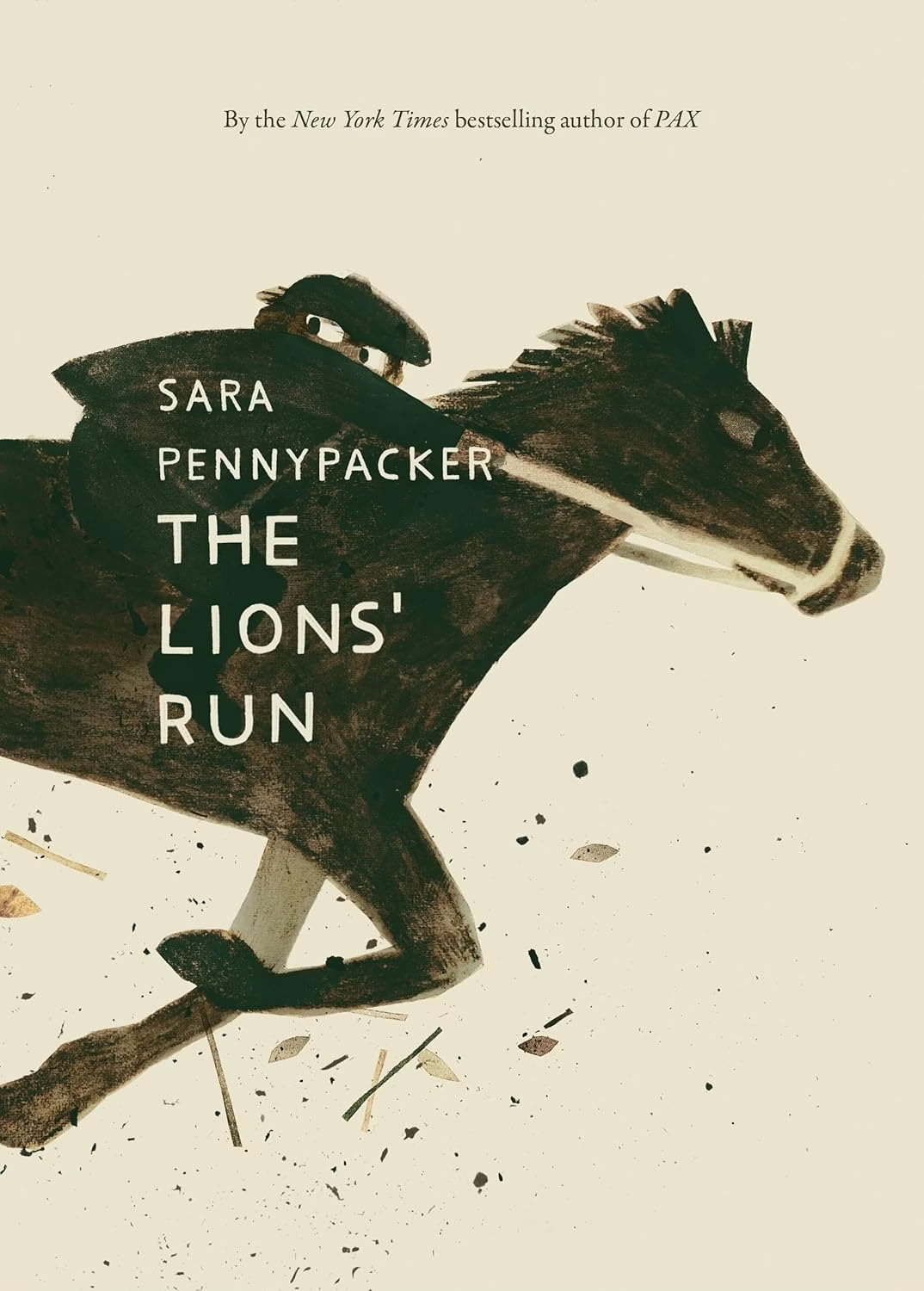
The acclaimed, New York Times bestselling author of Pax delivers an historical novel about an orphan during WWII who discovers unexpected courage within himself when he becomes involved with the Resistance.

Petit éclair. That’s what the other boys at the orphanage call Lucas DuBois. Lucas is tired of his cowardly reputation, just as he’s tired of the war and the Nazi occupation of his French village. He longs to show how brave he can be.

He gets the chance when he saves a litter of kittens from cruel boys and brings them to an abandoned stable to care for them. There he comes upon a stranger who is none too happy to see him: Alice, the daughter of a horse trainer, who is hiding her filly from German soldiers.

Soon Lucas begins to realize they are not the only ones in the village with secrets. The housekeeper at the German maternity home and a priest at the orphanage pass coded messages; a young mother at the home makes dangerous plans to keep her baby from forced adoption; and a neighbor in town may be harboring a Jewish family.

Emboldened by the unlikely heroes all around him, Lucas is forced to decide how much he is willing to risk to make the most courageous rescue of all.

Perfect for fans of Alan Gratz, Ruta Sepetys, and Kimberly Brubaker Bradley, this accessible novel, told in short chapters, illuminates a little-known aspect of World War II history.

My Review

I could not put this book down. The author’s note at the beginning explains how Sarah Pennypacker learned about the Lebensborn program and the germination process of the idea that became The Lion’s Run.

The Lebensborn program is a part of history that I wasn’t familiar with. This was a Nazi program through which they planned to create a new generation of blond-haired, blue-eyed Germans. They did this by rounding up teenage girls who were pregnant by Nazi soldiers, imprisoning them in these Lebensborn facilities, where they were well-fed and cared for until the birth of their babies, when they were returned home. The babies were then forced into adoption.

Information about the program is pretty limited to keep the story appropriate for a middle grade audience. Lucas meets one of the moms and her baby and sympathizes with her over her situation. It’s also obvious that the girls living at the Lebensborn are well fed when everyone else in Lucas’s town is not getting enough to eat.

In terms of the story itself, I was wholly engrossed. Lucas wants to be brave and worries he isn’t. Yet, he saves kittens from drowning. He hides them, saving food from his own meager meals to give to the little furry critters. He also insists on helping adults in his life who are in the Resistance.

I loved how the story showed him processing the question of what it means to be brave and to help. What a timely message. This will resonate with both middle grade readers and older readers.

I highly recommend this book. It’s a great pick for readers interested in historical fiction, especially those who enjoy stories set during World War II. I think it’ll appeal to readers who like fast-paced stories, too.

Content Notes

Recommended for Ages 8 to 12.

Profanity/Crude Language Content
None.

Romance/Sexual Content
Lucas delivers groceries to a facility for pregnant teens called a Lebensborn. He befriends one of the young mothers and her newborn. Readers learn about the German initiative to imprison these girls, who are pregnant by Nazi soldiers, for the purpose of producing a new generation of blond-haired, blue-eyed children who are forced into adoptive homes in Germany.

Spiritual Content
Lucas lives at a Catholic convent and speaks with a priest who is part of the Resistance.

Violent Content
Situations of peril. A woman tells two boys to drown a litter of kittens they find near the convent. A boy throws a rock and hits another boy in the face. A boy buries broken glass in a dirt road, hoping to damage the tires of a German convoy. The story references other Resistance members who have been sent to concentration camps, or worse.

Drug Content
Before the babies at the Lebensborn are transported to Germany, the nurses add a drug to their milk so they’ll sleep through the trip.

Note: This post contains affiliate links, which do not cost you anything to use but help support this blog. I received a free copy of this book in exchange for my honest review. All opinions are my own.

Marvelous Middle-Grade Monday

I’m sharing this post as a part of a weekly round-up of middle-grade posts called Marvelous Middle-Grade Monday. Check out other blogs with posts about middle-grade books today on Marvelous Middle-Grade Mondays at Always in the Middle.

Review: Song of a Blackbird by Maria van Lieshout

Song of a Blackbird
Maria van Lieshout
First Second
Published January 21, 2025

Amazon | Bookshop | Goodreads

About Song of a Blackbird

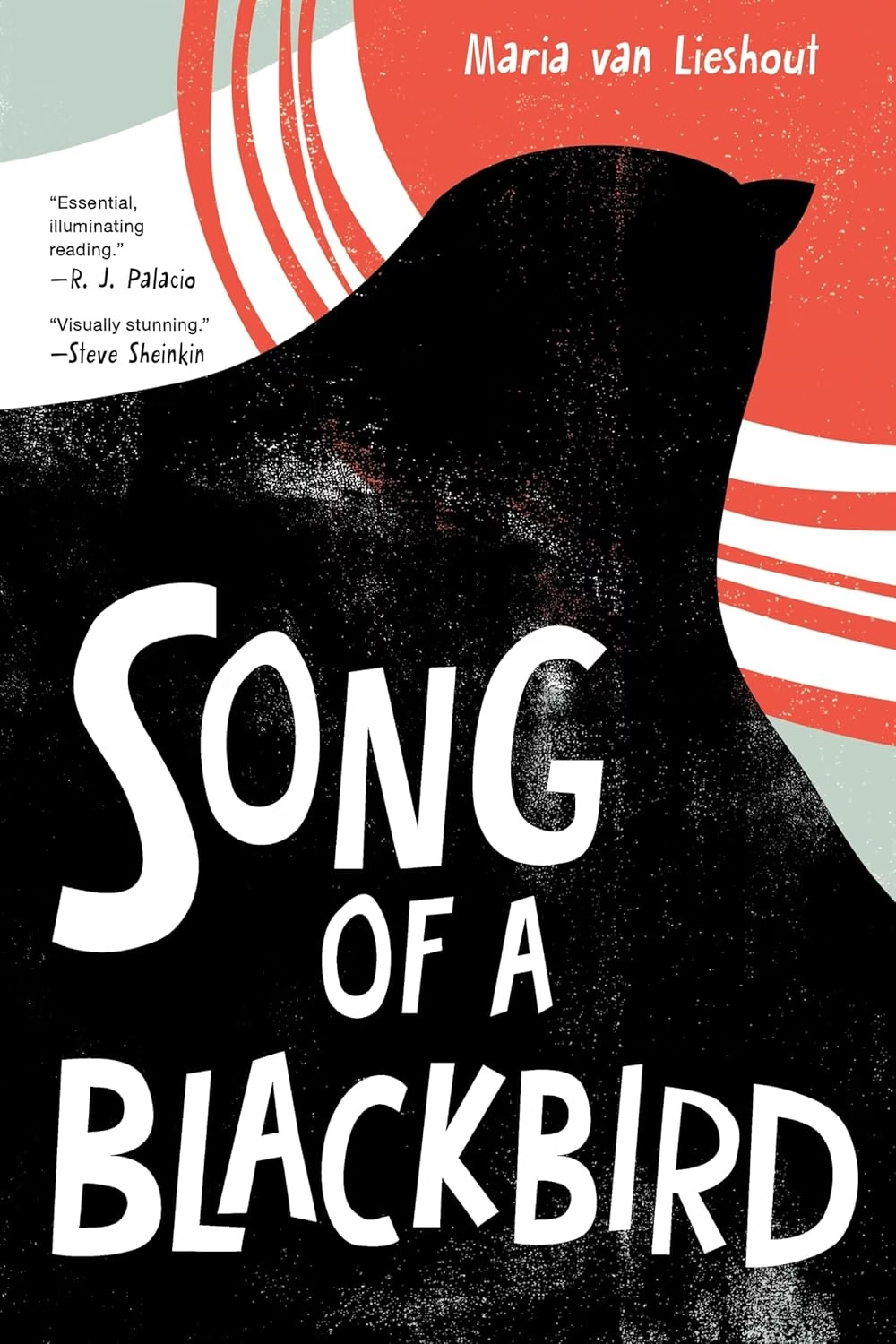
Fictionalized but based on true events, Song of a Blackbird has two intertwined timelines: one is a modern-day family drama, the other a thrilling tale of a WWII-era bank heist carried out by Dutch resistance fighters.

In the present day, teenage Annick is desperate to find a bone marrow donor that could save the life of her grandmother, Johanna. She turns to her family history and discovers a photograph taken by Emma Bergsma.

Decades earlier, Emma is a young art student about to be drawn into what will become the biggest bank heist in European history: swapping 50 Million Guilders’ worth of forged bank notes for real ones―right under the noses of the Nazis! Emma’s life―and the lives of thousands, including a young woman named Johanna―hangs in the balance.

In this stranger-than-fiction graphic novel, Maria van Lieshout weaves a tale about family, courage, and the power of art. Deeply personal yet universal, Song of a Blackbird sheds light on an untold WWII story and sends a powerful message about compassion and resistance.

My Review

I love that the narrator of the book is a blackbird representing the spirit of resilience and the power of compassion. The scenes alternate between two timelines: 1943 and 2011. In 1943, we follow Emma, a young woman who has just joined the Dutch resistance and agrees to help hide Jewish children scheduled for deportation. She winds up helping print forged ration cards and bank certificates as part of a heist plot.

In 2011, we follow a teenage girl whose grandmother has just learned she was one of the children hidden in Amsterdam and adopted by a non-Jewish family. Oma has leukemia and needs a bone marrow transplant, which makes it crucial that Annick, her granddaughter, help to track down her biological family.

Annick follows clues in a series of prints on her grandmother’s walls. Each section of the book begins with one of those prints and shows Annick’s research, as well as Emma, the artist who created the prints, and her work to hide Annick’s grandmother aid the resistance movement.

The use of the prints and the presence of artists in both time periods emphasize the importance of art as resistance and the powerful impact it has on its creator and viewers. Emma’s prints tell the story of her work, ensuring that history isn’t forgotten.

The illustrations are in grayscale except for a reddish-orange color. I love the way the author uses that orange to draw attention to certain elements. It also reminds me of sunrise, which made the color seem like a symbol of hope and resistance in and of itself.

The back of the book has some historical notes about each person who inspired characters in this graphic novel. Photographs of each person appear there, but Lieshout has also strategically placed photographs throughout the scenes of the book.

Concusion

I’m really blown away by how powerful this story is. I wasn’t sure I’d like the bird narration, but I really ended up loving it. The notes that piece together the truths that inspired the story are such a great addition. This is a story I’m not going to forget.

Content Notes

Recommended for Ages 13 up.

Profanity/Crude Language Content
Mild profanity used very infrequently.

Romance/Sexual Content
Allusion to the attraction between two people. One panel shows two teenagers kissing.

Spiritual Content
A priest helps hide several Jewish boys in his church.

Violent Content
References to deportations and rumors of execution at concentration camps. Mass arrests. Resistance workers know they can be arrested and interrogated or tortured. A man temporarily escapes soldiers, but has a gunshot wound that leaves his legs paralyzed. One scene shows a group of men (resistance members) executed by firing squad.

Drug Content
Panels show adults smoking and drinking alcohol in some scenes.

Note: This post contains affiliate links, which do not cost you anything to use but help support this blog. I borrowed a copy of this book from my local library. All opinions are my own.

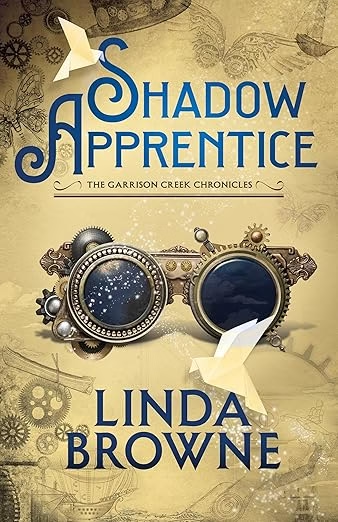
Review: Shadow Apprentice by Linda Browne

Shadow Apprentice (The Garrison Chronicles #1)
Linda Browne
Crooked Mile Media
Published May 8, 2024

Amazon | Bookshop | Goodreads

About Shadow Apprentice

FINALIST, THE WISHING SHELF BOOK AWARDS 2024

13-year-old Ermin is a gifted mechanic and the worst student at St. Anselm’s Training School for Orphans. She’s just failed her exams for the third time—something nobody’s ever done. Worse, Ermin’s been running her own repair business for money, something that’s expressly forbidden. If the headmistress finds out, Ermin will go to prison. Her future will be over before it’s even begun.

But that’s not her only secret.

Her best friends, Colin and Georgie, are wizards in a world where magic is strictly controlled. Ermin worries that her friends will be captured, drained of their power, then banished. When Georgie’s caught aiding the Wizard’s Resistance, Ermin repairs a broken flying carpet so all three of them can escape.

Hesitant to join the Resistance because of her lack of magical power, Ermin steals an experimental device from a wizard hunter that could destroy every wizard in the Creek. She’s faced with a choice: either smash the device or convert it into a different kind of weapon—one that not only helps wizards but just might get her an apprenticeship at the prestigious Guild Academy.

Ermin’s got one chance to get it right. If she fails, she risks losing her two best friends… and her dreams.

My Review

I read this book as a total impulse/mood read. I have a pretty structured review calendar, but I needed a break, so I browsed my Kindle app for something that would grab my attention. Initially, I planned to read the first page of the book and see what happened. The next time I looked up, I had read 25% of the story, and it was past bedtime. Ha!

Shadow Apprentice is a lean fantasy with memorable characters and a fast-paced plot. I loved the steampunk elements in the book. Ermin has a natural ability and intuition for fixing mechanical problems. What she doesn’t have, though, is a gift for working out complex spell equations, something she’ll need to continue with school and have a career fixing things.

The connection between magic and math through spellwork equations was a fascinating one. It made perfect sense in the story, and I’m sure many readers who struggle with math will identify with Ermin’s feelings about it.

Ermin and her two best friends are the central characters, although the story is told from Ermin’s perspective. I loved the way they look out for each other, even when they have different ideas about how to solve a problem they face.

The story world has a lot going on. At the beginning, Ermin is a student at a boarding school. Wizards, people with natural magical ability, are hunted, arrested, and stripped of their magic. Street gangs (made up mostly of kids) recruit other unhoused kids and press them into working for them. A resistance group opposes the treatment of wizards and fights against their unjust treatment.

Ermin and her friends find themselves caught between these warring factions. Figuring out who wants her help versus who plans to take advantage of her or her friends isn’t easy.

Conclusion

The plot gripped me all the way until the final pages of the book. I would absolutely read more of this series. I think fans of magic school type stories will like this one. It reminds me a little bit of The Hunt for the Hollower by Callie C. Miller.

Content Notes

Recommended for Ages 9 to 14.

Profanity/Crude Language Content
None.

Romance/Sexual Content
A few references to characters having crushes on other characters.

Spiritual Content
Some characters have the ability to perform magic.

Violent Content
Situations of peril. Ermin and her friends face threats from street gangs who would press them into working for them or banishment for those found to have magical ability.

Drug Content
Passing reference to pubs.

Note: This post contains affiliate links, which do not cost you anything to use but help support this blog. I purchased a copy of this book and enjoyed it so much I wanted to share my review. All opinions are my own.

MMGM Review: The Sky Was My Blanket by Uri Shulevitz

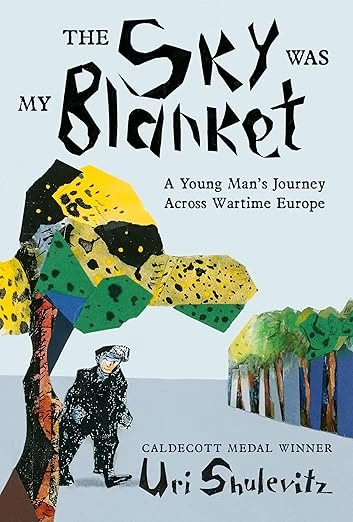
The Sky Was My Blanket: A Young Man’s Journey Across Wartime Europe
Uri Shulevitz
Farrar, Straus, & Giroux
Published August 12, 2025

Amazon | Bookshop | Goodreads

About The Sky Was My Blanket

From celebrated Caldecott Award–winning illustrator Uri Shulevitz comes the gripping and revealing true story of a young Polish exile fighting to survive in war-torn Europe.

Born in the tumult of World War I, a young Jewish boy named Yehiel Szulewicz chafes at the borders of his hometown of Żyrardów, Poland, and at the rules set in place by his restrictive parents. Brimming with a desire for true adventure, he leaves home at fifteen-and-a-half years old to seek his future elsewhere. Little does Yehiel know, he’ll never see his parents again.

His journey takes him beyond Polish borders, to Austria, Croatia, France, and Spain. With no money and no ID papers, he often sleeps under the stars, with only the sky as his blanket. But even wayfaring Yehiel can’t outrun the evil spreading across Europe in the years leading up to World War II. As the fascists and Nazis rise to power, Yehiel soon finds himself a member of the Spanish Republican Army and then the Jewish Resistance in Vichy France, fighting for freedom, his friends, and his very life.

Inspired by the true story of Uri Shulevitz’s uncle and stunningly illustrated by the author, The Sky Was My Blanket is a unique and riveting account of one man’s courage and resilience amidst one of the darkest periods in global history.

Don’t miss Uri Shulevitz’s acclaimed memoir, Chance: Escape from the Holocaust: Memories of a Refugee Childhood, which bestselling author Elizabeth Wein called “harrowing, engaging and utterly honest” (New York Times Book Review).

My Review

I really liked the way this book was written. Each part is broken into very short chapters, usually only a page or so of text, often accompanied by a drawing. This allows the story to focus on the critical moments of Yeheil’s journey. It feels exactly like the snippets you might get when you sit down to ask a relative to tell their life story.

It’s also the kind of information that you’d tell an interested child if you were relating your experiences, so it doesn’t delve too deeply into the horrors of war that Yeheil must have witnessed.

Many of the World War II stories that I’ve read following Jewish characters relate experiences in Concentration Camps, and those are critically important stories to tell. (Perhaps only more important now.) Still, this narrative reminds readers that those aren’t the only experiences of war survivors.

I haven’t read Uri Shulevitz’s memoir, Chance: Escape from the Holocaust: Memories of a Refugee Childhood but after reading his account inspired by his uncle’s life, it’s high on my reading list.

Content Notes

Recommended for Ages 10 to 14.

Profanity/Crude Language Content
None.

Romance/Sexual Content
Reference to marriage.

Spiritual Content
Reference to Jewish faith and traditions.

Violent Content
Situations of peril. Reference to ghettos and concentration camps.

Drug Content
None.

Note: This post contains affiliate links, which do not cost you anything to use but help support this blog. I received a free copy of this book in exchange for my honest review. All opinions are my own.

Marvelous Middle-Grade Monday

I’m sharing this post as a part of a weekly round-up of middle-grade posts called Marvelous Middle-Grade Monday. Check out other blogs with posts about middle-grade books today on Marvelous Middle-Grade Mondays at Always in the Middle.

Review: Focus. Click. Wind. by Amanda West Lewis

Focus. Click. Wind.
Amanda West Lewis
House of Anansi
Published August 1, 2023

Amazon | Bookshop | Goodreads

About Focus. Click. Wind.

What if your country is involved in an unjust war, and you’ve lost trust in your own government?

It’s 1968, and the Vietnam War has brought new urgency to the life of Billie Taylor, a seventeen-year-old aspiring photojournalist. Billie is no stranger to risky situations, but when she attends a student protest at Columbia University with her college boyfriend, and the US is caught up in violent political upheaval, her mother decides to move the two of them to Canada.

Furious at being dragged away from her beloved New York City to live in a backwater called Toronto, Billie doesn’t take her exile lightly. As her mother opens their home to draft evaders and deserters, Billie’s activism grows in new ways. She discovers an underground network of political protesters and like minds in a radical group based in Rochdale College, the world’s first “free” university. And the stakes rise when she is exposed to horrific images from Vietnam of the victims of Agent Orange – a chemical being secretly manufactured in a small town just north of Toronto.

My Review

For some reason when I first picked up this book, I mistook it for nonfiction. I’m not sure if I skimmed the cover copy and author bio so quickly that the two merged together (there are similar elements in them)? I don’t know. At any rate, sometime during my reading, I realized it was a novel about the Vietnam War resistance movement in the 1960s.

This is a time period that I don’t know a lot about. I used to blame this on my history classes in school, because we never went beyond World War II and some light information about the Civil Rights movement during February. I’m not old enough for that to make any sense, but I do live in Florida, so there ya go, I guess.

Anyway, so I read this novel without a strong understanding of the history to which it refers. I’ve known a few veterans of the Vietnam War, and it did make me think of things they’ve endured or talked about because of the war. One believes his children’s health issues stem from his exposure to Agent Orange. Two more were addicted to drugs and alcohol following their military service. So, I’ve definitely seen some of the effects mentioned in the book.

The writing is super compelling. The story is told in present tense, and it begins with the main character, Billie, at a student protest at Columbia. I loved the way she uses her photographs to tell the story of what she’s experiencing. I thought the descriptions of her taking photographs and developing them were very engaging.

Billie has some memories of her father using drugs and being involved in a drug deal that goes badly. She remembers hiding under a table with her mother while someone has a gun. Her mom responds to this by deciding she will never allow another person who uses drugs to live in her house. As Billie forms connections to others who protest the Vietnam War, she meets a lot of people who use drugs.

Though this is set in the 60s and the prevalent use of drugs, especially marijuana, seems realistic, I found myself wishing that the author explored some of the nuances of addiction as a disorder and maybe at least questioned her mom’s hardline position. The story really isn’t about that issue, though, and the author leaves that territory unexplored.

All in all, I think the writing was spectacular. It’s got some mature content which won’t be suitable for every reader. I’ve detailed that below.

Content Notes

Recommended for Ages 17 up.

Representation
Major characters are white.

Profanity/Crude Language Content
Extreme language used somewhat frequently.

Romance/Sexual Content
A couple of scenes show explicit sex between boy and girl. In one scene, two boys try to convince a girl to have sex with them and another girl. She refuses.

Spiritual Content
None.

Violent Content
When Billie was a child, her dad was involved in a drug deal that went awry. She and her mother hid under a table while guns and conflict happened. Descriptions of warfare and the devastation caused by Agent Orange.

Drug Content
Characters drink alcohol and smoke a lot of weed. The story briefly states that a lot of soldiers become addicted to heroin because the government is handing it out to them to help them deal with the horrors of war.

Note: This post contains affiliate links, which do not cost you anything to use, but which help support this blog. I received a free copy of FOCUS. CLICK. WIND. in exchange for my honest review. All opinions my own.