Tag Archives: USSR

Chernobyl, Life and Other Disasters by Yevgenia Nayberg

Review: Chernobyl, Life, and Other Disasters by Yevgenia Nayberg

Chernobyl, Life, and Other Disasters
Yevgenia Nayberg
Holiday House
Published April 14, 2026

Amazon | Bookshop | Goodreads

About Chernobyl, Life, and Other Disasters

Strong-willed Genya sets her mind to attending art school in 1980s Ukraine, amidst the turmoil of Soviet control, the Cold War, and the unfolding Chernobyl nuclear disaster.

Genya—the nickname of the book’s author and story’s protagonist, Yevgenia—knows from age five that she wants to be an artist. When she turns eleven, she’ll apply to the same prestigious art school that her mother attended. But making the cut won’t be easy, especially with the school’s open-secret rule that no more than 1% of the student body can be Jewish.

The years before Genya’s eleventh birthday bring plenty to distract her. Nothing in Soviet Ukraine is quite as it seems; adults mock the government, but only in private; and her classmates are terrified of American bomb strikes. And that’s all before April 26, 1986, when Genya’s police officer neighbor gets called to an emergency in a town she’s never heard of: Chernobyl.

A graphic memoir account of creator Yevgenia Nayberg’s childhood, Chernobyl, Life, and Other Disasters is both deeply personal and a glimpse into broader Soviet intelligentsia experiences. Young readers curious about life elsewhere, particularly in the face of disaster, will find ample details to devour, while those dreaming of a creative life will take inspiration from Genya’s perseverance. Salient and yet often slyly funny, this is a must-read for any graphic memoir fan.

My Review

Genya wants to go to art school, but while she’s preparing, a reactor at Chernobyl explodes, upending her life. I really appreciate that, though her memories about the Chernobyl disaster are striking, the story is framed by her larger childhood goals and experiences.

In some ways, this story made me think of what it must have been like for children during the COVID-19 pandemic. The news was often shocking and riddled with more questions than answers. In the absence of information, people tried to protect themselves however they could (microwaving their groceries before putting them away, for example).

Though it’s a completely different situation, I suspect that some readers will identify with Genya’s experience. She tries to live her normal life and balks at the strange requests that adults make, even when those turn out to be decisions that keep her safer.

The writing and illustrations pair in very clever ways, playfully examining how children interpret what’s happening around them and discover hard truths about life.

This book was a lot of fun to read. Fans of Eugene Yelchin‘s work will not want to miss this.

Content Notes

Recommended for Ages 10 to 14.

Profanity/Crude Language Content
None.

Romance/Sexual Content
One panel shows a friend telling Genya that parents have sex to make a baby. Later, Genya reads a human biology book, and is horrified to discover that menstruation is actually a thing that many women experience every month.

Spiritual Content
None.

Violent Content
Fear and rumors about potential American bomb strikes. References to prejudice against Jewish people. References to the oppressive government regime. References to deaths caused by radiation exposure and fears about spreading contamination.

Drug Content
None.

Note: This post contains affiliate links, which do not cost you anything to use but help support this blog. I received a free copy of this book in exchange for my honest review. All opinions are my own.

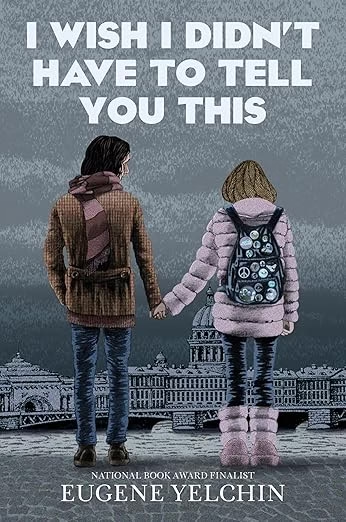
Review: I Wish I Didn’t Have to Tell You This by Eugene Yelchin

I Wish I Didn’t Have to Tell You This
Eugene Yelchin
Candlewick Press
Published September 16, 2025

Amazon | Bookshop | Goodreads

About I Wish I Didn’t Have to Tell You This

In a stunning sequel to The Genius Under the Table, Eugene Yelchin’s graphic memoir depicts his harrowing journey from Leningrad’s underground art scene to a state-run Siberian asylum—and to eventual safety in the US.

No longer the creative little boy under his grandmother’s table, Yevgeny is now a young adult, pursuing his artistic dreams under the constant threat of the KGB’s stranglehold on Russia’s creative scene. When a chance encounter with an American woman opens him up to a world of romance and possibility, Yevgeny believes he has found his path to the future—and freedom overseas.

But the threat of being drafted into the military and sent to fight in Afghanistan changes everything in a terrible instant, and he takes drastic measures to decide his fate, leading to unthinkable consequences in a mental hospital.

With bold art bringing a vivid reality to life, National Book Award Finalist and Newbery Honoree Eugene Yelchin’s sequel to the acclaimed memoir The Genius Under the Table returns to Yevgeny’s saga, balancing the terror and oppression of Soviet Russia with the author’s signature charm and dark wit. I Wish I Didn’t Have to Tell You This shines a stark spotlight on history while offering a poignant, nuanced, and powerfully resonant look at growing up in—and ultimately leaving—Cold War Russia in the early 1980s.

My Review

I have not read The Genius Under the Table, so if there are references to that book in I Wish I Didn’t Have to Tell You This, then I missed them. Despite that, I followed the story just fine as I read this memoir. I don’t know that I realized it was a sequel as I was reading it.

The story can be grim, which won’t surprise anyone familiar with Russian history in the early 1980s. Yelchin does a wonderful job incorporating art, joy, and humor into the story, though. Yevgeny’s relationship with Libby is halting and sweet. I loved watching them figure out how to communicate with each other and the jokes they developed. For instance, they would ask each other if the other was “mixed up” about them, meaning did they have romantic feelings for one another.

It was easy to feel the tension Yevgeny felt as an artist. He knew he could be imprisoned, or worse, for making art. Late in the book, he is confined to a mental institution. At one point, a scene sort of fades to black, with Yevgeny in pretty dire straits. When the narrative resumes, we learn that he still carries the trauma of his experience, but has been freed.

Throughout the story, the narrative stays appropriate to the audience. The illustrations don’t show gratuitous violence, though the characters reference a murder that happens off-scene. The story also notes Russia’s invasion of Afganistan, and the high cost to human life the war creates.

At 432 pages, this graphic memoir is a little longer than other similar books, but it’s so worth reading. I loved the expressions on the characters’ faces. The illustrations are brilliant. Readers interested in European or Russian history will not want to miss this one.

Content Notes

Recommended for Ages 12 up.

Profanity/Crude Language Content
None.

Romance/Sexual Content
Kissing. Yevgeny’s grandmother inquires that he and his wife will not have privacy while they sleep if she moves in with the family.

Spiritual Content
None.

Violent Content
References to political assassination and bullying. References to antisemitism. At one point, Yevgeny is in a medical facility, and the scene sort of fades to black with a vague reference to torture and mistreatment.

Drug Content
Yevgeny goes to a party and possibly gets drunk? He falls down dancing and then walks home alone. It’s hard to tell if there was alcohol involved. If so, it’s not pictured. Characters smoke cigarettes in some scenes. Someone injects medication into a person’s arm without their consent.

Note: This post contains affiliate links, which do not cost you anything to use but help support this blog. I received a free copy of this book in exchange for my honest review. All opinions are my own.