

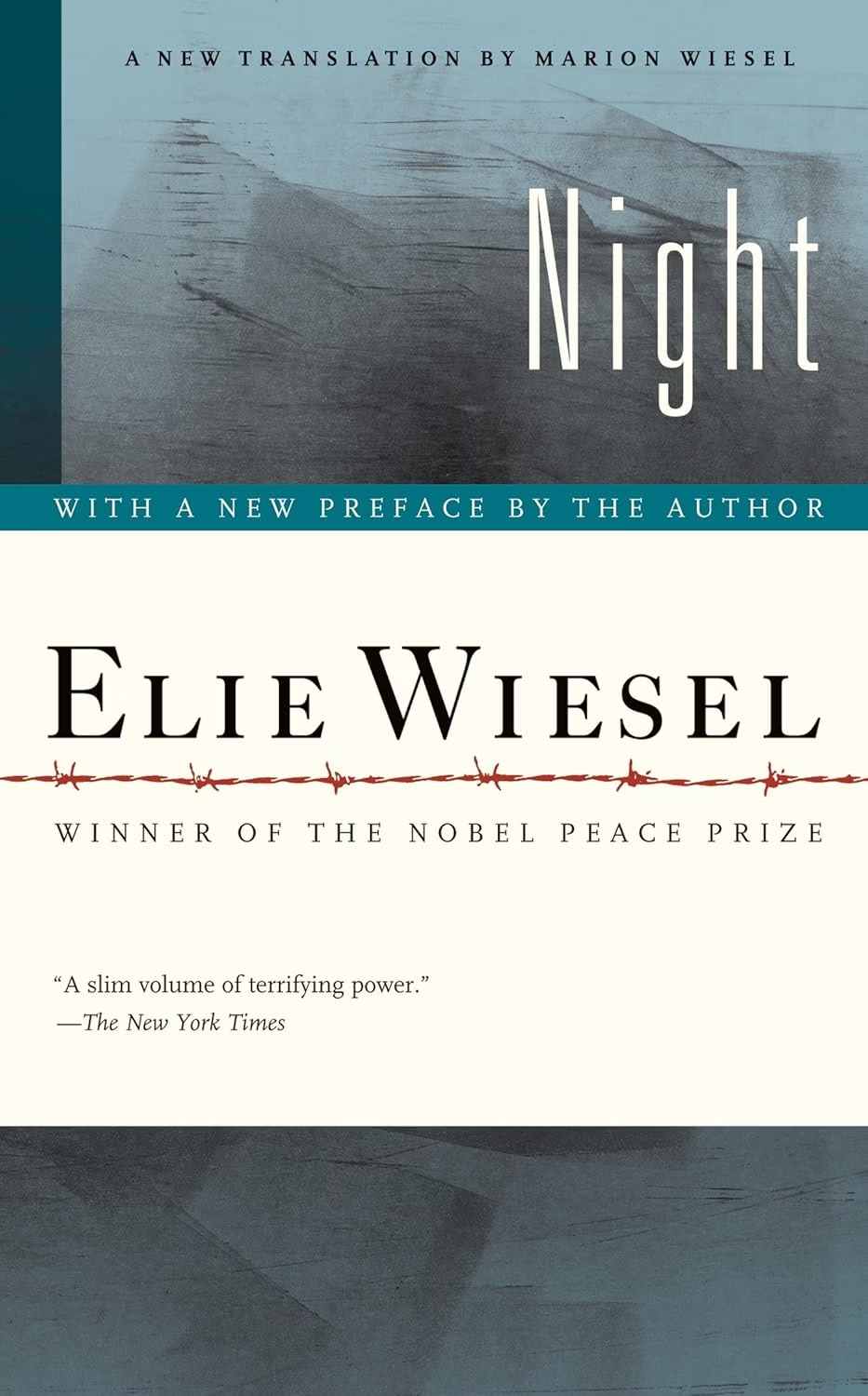
Night (Night Trilogy #1)
Elie Wiesel
Translated by Marion Wiesel
Hill and Wang
Published January 16, 2006 (Orig. 1956)
Amazon | Bookshop | Goodreads
About Night
Born in the town of Sighet, Transylvania, Elie Wiesel was a teenager when he and his family were taken from their home in 1944 to Auschwitz concentration camp, and then to Buchenwald.
Night is the terrifying record of Elie Wiesel’s memories of the death of his family, the death of his own innocence, and his despair as a deeply observant Jew confronting the absolute evil of man.
This new translation by his wife and most frequent translator, Marion Wiesel, corrects important details and presents the most accurate rendering in English of Elie Wiesel’s testimony to what happened in the camps and of his unforgettable message that this horror must simply never be allowed to happen again.


My Review
I first read this memoir years ago, but Wiesel’s words have stayed with me since. It’s been on my list to reread this book for a long time. This year seemed like the right time.
The author describes some horrifying things in plain language, describing a situation and reflecting on how he felt in the moment or immediately afterward. A few of the descriptions are hard to read, especially those involving children. While Wiesel doesn’t graphically describe these cruelties, his words are shocking, and we feel his own shock as he witnesses them firsthand.
This isn’t a long book. In less than 150 pages, the author briefly describes the small town where he grew up, his family, and the closing in of his world as his family and his Jewish neighbors are forced into ghettos and then deported to concentration camps in other countries. There, they face torture, starvation, and neglect. Elie Wiesel was fifteen when he entered Auschwitz.
As I read, I kept having to pause and close the book. To think. To let the echoes of the author’s words ring out over me. I wanted to resist knowing the depth of the horrors he described, yet I needed to bear witness to his account.
This is a hard book to read, and an essential one, alongside Anne Frank’s Diary of a Young Girl and Boy from Buchenwald by Robbie Waisman (who knew Elie Wiesel and was at Buchenwald with him when the camp was liberated).
If you want to know more about what happened to the teen boys who were liberated from Buchenwald, I highly recommend Robbie Waisman’s book for that as well.
International Holocaust Remembrance Day
January 27, 2026, is International Holocaust Remembrance Day. It’s meant to be a day that we honor and remember the victims of the Holocaust. Remembering what happened, understanding the route that led humanity to that dark place, is necessary not only to honor those who died but to prevent these atrocities from happening again.
We cannot prevent this from happening again without acknowledging the truth of history and carrying that torch forward.

Content Notes
Recommended for Ages 14 up.
Profanity/Crude Language Content
One homophobic comment and a few uses of the G-slur.
Romance/Sexual Content
One vague reference to child trafficking within the camp. In one scene, Eliezer sees a camp officer having intercourse with a woman. The scene is quick and not detailed.
Spiritual Content
The memoir details Wiesel’s desire as a child to study his faith deeply. During his time in Auschwitz and Buchenwald, he wrestles with anger toward God for what has happened to him and others.
Violent Content
Brief, horrifying descriptions of the murder of children, including babies. Descriptions of cruel and inhumane treatment of those imprisoned in the camps. Brief descriptions of prisoners, including a child, executed by hanging. Wiesel describes deep shame as he makes decisions based on self-preservation rather than compassion for others, including his father.
Drug Content
None.
Note: This post contains affiliate links, which do not cost you anything to use but help support this blog. I purchased a copy of this book. All opinions are my own.
