


I don’t post many author interviews these days, but I enjoy them. It’s rare that I have a chance to ask questions of an author as widely known as this one. His latest book, I Wish I Didn’t Have to Tell You This, is as haunting as it is relevant.
I read I Wish I Didn’t Have to Tell You This last year, around the end of the summer. It left me thinking about the choices we face as individuals and how we each play a role in a larger story. When I wrote these questions back in November, I had no idea how differently I’d view them after what’s happened in the last two months. I’m grateful for his perspective and willingness to share his hard-won wisdom so frankly.
Note: This post contains affiliate links.
Q&A with Eugene Yelchin
1. In the opening scenes of I Wish I Didn’t Have to Tell You This, you share how your engagement with one of your favorite novels, War and Peace, evolved as you grew up. Has that evolution continued for you? Are there components of Tolstoy’s novel that stand out to you more now than they did before you left Russia?
I still read Tolstoy, but I read him differently than when I was young. Tolstoy’s study of the human nature still fascinates me, but his psychological insights, which guided me in my youth, now serve a different purpose. I’m less interested in “what” than in “how”. Often, Tolstoy creates a dramatic situation and allows us to view it through several points of view simultaneously. Each point of view is unique, and the characters’ reactions to the situation — expectations, assumptions, illusions, disappointments, etc.— reveal those characters’ psyche. There’s much to learn from Tolstoy, and every time I go back to his work, I learn something new.
2. How was writing I Wish I Didn’t Have to Tell You This different than your memoir of your earlier childhood?
The Genius Under the Table wrote itself. It was the easiest and the most pleasurable experience I have ever had writing. The book is about my family, who despite the constant state of terror, vigilance, and doom managed to fill me with so much of their nutty and noisy Jewish love that it will outlast me and will go on and on in my children and hopefully, their children too. By contrast, I Wish I Didn’t Have to Tell You This was the most difficult project that I have ever attempted exactly because that constant state of terror, vigilance, and doom is also alive and present in me. As a result, reinhabiting the times and the places that I have been trying to forget for years was extremely challenging. But on the brighter side, probably because it was the most difficult book I have ever made, it might also be my best, at least judging by the reaction it receives.
3. Despite the terror and hardship your memoir captures, the story has a lot of humor in it. How did your sense of humor help you through your experiences?
I realize that there is a common belief that humor is helpful in difficult times, and maybe it is, I am not sure. In the case of I Wish I Didn’t Have to Tell You This, humor serves mostly to ease the American readers into the dramatic situations, which (so far) are not familiar to them. At the time and the place described in the book — the Soviet Union of the early 1980s — the humor was much, much darker than I use in the book. The Soviet humor of that period was the humor of a condemned man, the humor of a nihilist. The book is written for the American teens, and I had to be very careful keeping a grip on the sense of despair and hopelessness I had felt back then so that the young American readers will keep reading the book now.
4. When you look at events unfolding in the United States today, do you spot parallels between the government of the Soviet Union and the government of the US? Do you have any advice for young people today who are concerned about the current state of the US and global political climate?
In 2017, the brilliant American thinker, Timothy Snyder, wrote in his pamphlet on tyranny, “When the men with guns who have claimed to be against the system start wearing uniforms and marching with torches and pictures of a leader, the end is nigh. When the pro-leader paramilitary and the official police and military intermingle, the end has come.” It is inspiring to know that even an expert like Snyder could have underestimated American people. The peaceful resistance in Minnesota had proved to us that the end is nowhere in sight. My advice for young people is no different than they have already heard from so many others — join in the peaceful protests (the numbers matter!) and under no circumstances cooperate with the tyrannical regime. Even if it means walking out on the job or out of the classroom, loss of money, comfort, loss of things that we take for granted. Do it now, and that loss will be temporary. Do nothing, and the loss of life itself will not be out of the question in the future.
5. Is there something you wish you had known as a young man that you want to pass on to this new generation?
First and foremost, trust your instincts. We live in the culture, which is loud, pervasive, highly consumerist. This culture forces us to become not who we are but whom it wants us to be. It wants us to be consumers, not citizens. Resist it. Slow down. Question everything and everyone. Do not act emotionally; even if you feel something, it doesn’t mean that it’s true. To learn how to trust your instincts, read real literature.
6. What do you most hope that readers take away from your memoir?
When I began work on the book about living under an oppressive regime, I envisioned it as a warning to those living in freedom. Democracy is rare and fragile; what would Americans do if they were at risk of losing it? It was a hypothetical question but soon after the book was released, Americans were on the streets protesting the rise of tyranny with No Kings marches. My hope is that my readers will not take democracy they had inherited for granted. That courage is required to defend it. Individually they may not have that courage, but united, they do.
7. What is one question about your memoir that readers often ask you?
Is it true?
Yes, it is.


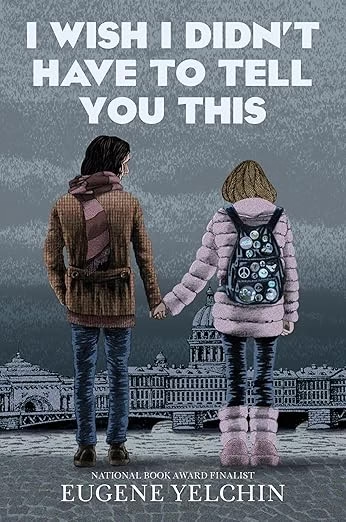
About I Wish I Didn’t Have to Tell You This
Amazon | Bookshop | Goodreads | My Review
In a stunning sequel to The Genius Under the Table, Eugene Yelchin’s graphic memoir depicts his harrowing journey from Leningrad’s underground art scene to a state-run Siberian asylum—and to eventual safety in the US.
No longer the creative little boy under his grandmother’s table, Yevgeny is now a young adult, pursuing his artistic dreams under the constant threat of the KGB’s stranglehold on Russia’s creative scene. When a chance encounter with an American woman opens him up to a world of romance and possibility, Yevgeny believes he has found his path to the future—and freedom overseas.
But the threat of being drafted into the military and sent to fight in Afghanistan changes everything in a terrible instant, and he takes drastic measures to decide his fate, leading to unthinkable consequences in a mental hospital.
With bold art bringing a vivid reality to life, National Book Award Finalist and Newbery Honoree Eugene Yelchin’s sequel to the acclaimed memoir The Genius Under the Table returns to Yevgeny’s saga, balancing the terror and oppression of Soviet Russia with the author’s signature charm and dark wit. I Wish I Didn’t Have to Tell You This shines a stark spotlight on history while offering a poignant, nuanced, and powerfully resonant look at growing up in—and ultimately leaving—Cold War Russia in the early 1980s.


About Eugene Yelchin
Eugene Yelchin is a National Book Award finalist for The Assassination of Brangwain Spurge co-authored with M. T. Anderson and the recipient of Newbery Honor for Breaking Stalin’s Nose. He received Sydney Taylor Award for The Genius Under the Table, Golden Kite Award for The Haunting of Falcon House, Crystal Kite Award for illustrating Won Ton, National Jewish Book Award for illustrating The Rooster Prince of Breslov, and Tomie DePaola Award from the Society of Children Books Writers and Illustrators. His books were named Best Books of the Year by the New York Times, People Magazine, Wall Street Journal, Washington Post, Boston Globe, USA Today, Amazon, NPR, Huffington Post, Publishers Weekly, Kirkus Reviews, Horn Book, School Library Journal, etc., and were translated in fourteen languages.


