Tag Archives: segregation

Review: Roll of Thunder, Hear My Cry by Mildred D. Taylor

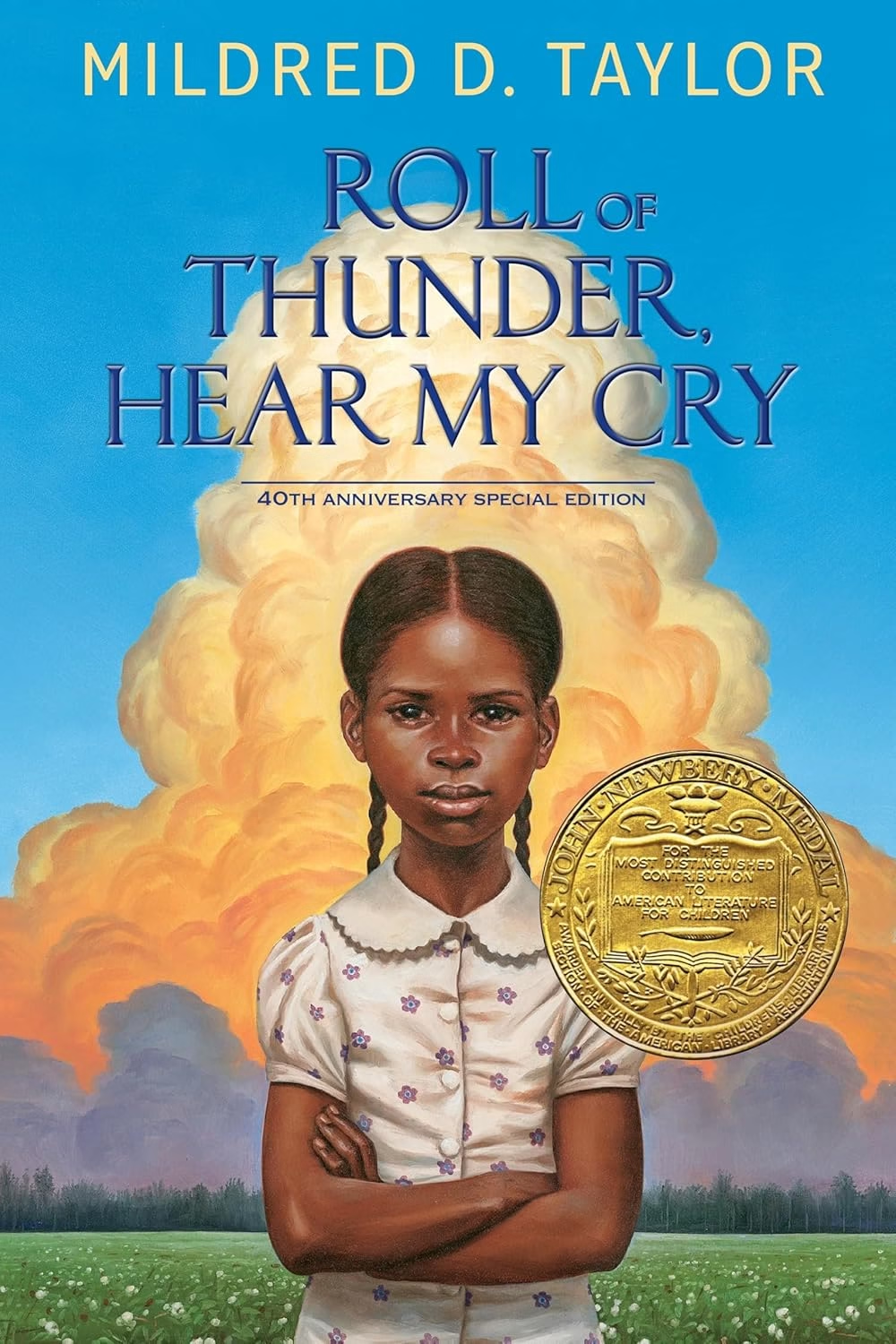
Roll of Thunder, Hear My Cry by Mildred D. Taylor

Roll of Thunder, Hear My Cry (The Logan Family Saga #4)
Mildred D. Taylor
Dial Books
Published January 5, 2016

Amazon | Bookshop | Goodreads

About Roll of Thunder Hear My Cry

Mildred D. Taylor’s Newbery Award-winning masterpiece with an introduction written and read by Jacqueline Woodson, just in time for its 40th anniversary!

Set in Mississippi at the height of the Depression, this is the story of one family’s struggle to maintain their integrity, pride, and independence in the face of racism and social injustice. And it is also Cassie’s story – Cassie Logan, an independent girl who discovers over the course of an important year why having land of their own is so crucial to the Logan family, even as she learns to draw strength from her own sense of dignity and self-respect.

My Review

I first read this book in fourth grade, but I wanted to revisit the story again. I remembered it being incredibly powerful– and it is. Cassie’s strength and boldness make her such a great character as she grapples with the difference between how she sees herself and how her white neighbors treat her. Her understanding of justice and fairness and the pain she feels when the town she lives in reveals itself as an unjust, unfair place hits deep.

The story shows the ugliness of Jim Crow laws, segregation, and racism, but also highlights the power of community, family bonds, and determination. Because we see the world through Cassie’s youthful gaze, the story stays within a child’s understanding. Many of the cruel or violent acts take place off-scene and are either recounted to Cassie later or only hinted at.

The version of the book that I read included an author’s note in which Mildred D. Taylor talked about the inspiration for her book and the song by the same title that appeared in her mind one day. As the final scenes of the story played out, I thought again about the way that the characters cry out for justice in an unjust system, and how the rain, more than once, opens an avenue for justice or aid for them.

There are a lot more books in this series than I initially realized. Some are novellas. I’ve only ever read this and Let the Circle Be Unbroken, but I’m anxious to read the other stories about the Logan family.

Content Notes

Recommended for Ages 10 to 12.

Profanity/Crude Language Content
Some brief use of the n-word.

Romance/Sexual Content
None.

Spiritual Content
References to attending church and revival services.

Violent Content
References to racially motivated crimes against Black people. Cassie learns that white men lit three Black men on fire in a nearby town. A white man wrenches her arm behind her back and forces her off the sidewalk before demanding that she apologize for refusing to move for a white girl. Cassie speaks up when a white store owner leaves off filling her friend’s order to assist white customers. The store owner throws her out of the shop. Cassie hears about a violent robbery. An injured boy tells Cassie that two young white men attacked him. A white man shoots a Black man on the road.

Drug Content
None.

Note: This post contains affiliate links, which do not cost you anything to use but help support this blog. I borrowed a copy of this book from the public library. All opinions are my own.

Review: I Know Why the Caged Bird Sings by Maya Angelou

I Know Why the Caged Bird Sings
Maya Angelou
Random House
Published April 21, 2009 (Orig. 1969)

Amazon | Bookshop | Goodreads

About I Know Why the Caged Bird Sings

Here is a book as joyous and painful, as mysterious and memorable, as childhood itself. I Know Why the Caged Bird Sings captures the longing of lonely children, the brute insult of bigotry, and the wonder of words that can make the world right. Maya Angelou’s debut memoir is a modern American classic beloved worldwide.
 
Sent by their mother to live with their devout, self-sufficient grandmother in a small Southern town, Maya and her brother, Bailey, endure the ache of abandonment and the prejudice of the local “powhitetrash.” At eight years old and back at her mother’s side in St. Louis, Maya is attacked by a man many times her age—and has to live with the consequences for a lifetime. Years later, in San Francisco, Maya learns that love for herself, the kindness of others, her own strong spirit, and the ideas of great authors (“I met and fell in love with William Shakespeare”) will allow her to be free instead of imprisoned.
 
Poetic and powerful, I Know Why the Caged Bird Sings will touch hearts and change minds for as long as people read.

I Know Why the Caged Bird Sings liberates the reader into life simply because Maya Angelou confronts her own life with such a moving wonder, such a luminous dignity.”—James Baldwin

Thoughts About Reading I Know Why the Caged Bird Sings

As I read this book, I thought back through my English literature education. Other than at least one poem by Langston Hughes in seventh grade, I can’t remember specifically reading any Black authors. It’s possible we read poetry by Maya Angelou. I especially do not remember ever reading about life in segregated America from a Black perspective, which seems like a huge thing when I think about it.

It is honestly a little bit alarming to me that I’m this old and just now reading I Know Why the Caged Bird Sings for the first time. I’ve read a pathetically small amount of classic literature by Black authors and/or authors of color in general. This is a problem I’m working to fix.

My Review

I love the way the author describes things. Some of the descriptions are pure poetry. Others vividly recount a moment or experience with such specificity that I felt like I was there witnessing the scene.

I listened to the audiobook version, read by the author, which I deeply enjoyed. She sings the hymns written in the text. She reads in a way that shows off the beauty of the poetic descriptions in the text while inviting the reader into each moment.

As I mentioned above, I think this is the first book I’ve read that shows segregated life in America from a Black perspective. (The more I think about it, the more I think that should absolutely be a requirement for high school literature. Wow.) I’m not sure I will ever forget the scene in which Maya and her brother hide her uncle in a vegetable bin and pile onions and potatoes on top of him because they’ve been warned that the Klan will be riding through their town looking for someone to harm.

The author describes the people in her life really well, too. As I read, I could sense both her admiration and her frustration with her mother and grandmother. These were both strong women with different values. They protected her and wounded her, sometimes knowingly, and sometimes without meaning to do so.

Conclusion

I’m so glad I read this book. It’s haunting and beautiful. There are some scenes that are hard to read (see content warnings below), but I really believe books like this are important. I am looking forward to reading more of Maya Angelou’s work.

Content Notes

Recommended for Ages 16 up.

Profanity/Crude Language Content
A couple uses of the N-word as Maya heard it used. In one scene, she lists other derogatory terms she heard used.

Romance/Sexual Content
A man abuses Maya (a child) multiple times, the last time being the most violent. Descriptions are brief. It’s hard to read, but it does show the trauma and the complicated feelings and conclusions she drew from the experience as a child.

Maya worries about her body’s development. She reads about lesbianism and intersex conditions at the library and then speaks with her mom, who helps her understand that what’s happening to her body is normal development. There’s a little bit of biological description here.

One scene briefly relates Maya’s first (consensual) sexual experience. It’s not very specific except to relate how functional rather than romantic it was.

Spiritual Content
References to attending church and singing hymns. Maya’s grandmother, Mama, believes that if you’re good, God will love you.

Violent Content
Brief mentions of harm to children. Maya’s uncle threatens to burn her on the stove if she can’t answer his questions. She believes, looking back, that he never would have harmed her. Reference to a woman hitting a child’s legs with a switch if they didn’t wash properly or teachers striking the palms of students with rulers if they disobeyed.

Maya’s grandmother hits her as punishment for using the term “by the way,” which her grandmother considers swearing.

Drug Content
Several scenes reference adults smoking cigarettes.

Note: This post contains affiliate links, which do not cost you anything to use but help support this blog. All opinions are my own.